Global Market Analysis of Ignition Systems: The Transition to Electric Arc Lighters and the Environmental Economics of Sustainable Alternatives
Analyzes the global lighter market's transition to electric arc lighters, detailing economic growth and environmental benefits over fossil-fuel disposables.
Global Market Analysis of Ignition Systems: The Transition to Electric Arc Lighters and the Environmental Economics of Sustainable Alternatives
Global Market Dynamics and Segmentation of the Lighter Industry
Macro-Economic Sizing and Projections
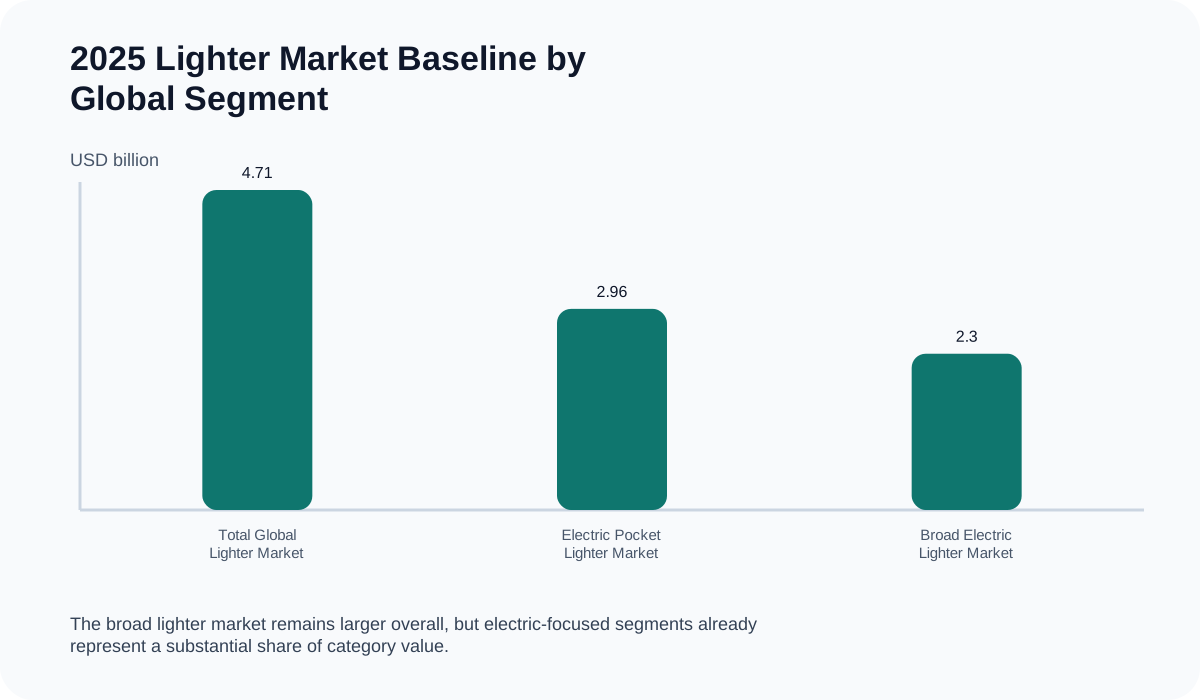
The global lighter market in 2026 exhibits a dual-track economic landscape, characterized by the maturity of legacy fossil-fuel products and the rapid expansion of sustainable electric ignition systems. The total global lighter market is valued at USD 4.77 billion in 2026, and is projected to expand at a compound annual growth rate (CAGR) of 1.29% to reach USD 5.36 billion by 2035. While traditional disposable lighters retain a significant volume share, anti-smoking campaigns and stringent government regulations act as major market restraints, suppressing approximately 15% of the sector’s long-term growth potential.
In contrast, the electric pocket lighter segment has grown from USD 2.96 billion in 2025 to USD 3.13 billion in 2026. This segment is projected to achieve a CAGR of 5.10%, reaching a valuation of USD 4.20 billion by 2032. A broader look at the entire electric lighter market, which includes household utility and personal arc models, valued the category at USD 2.3 billion in 2025. It is projected to reach USD 2.5 billion in 2026 and USD 4.8 billion by 2034, registering an accelerated CAGR of 9.8%. This surge is primarily driven by the transition from fuel-powered lighters to USB-rechargeable models.
A concrete example of this sustainability narrative reaching mainstream audiences came on 2022-09-13, when the REIDEA S4 was featured by the Today Show of NBC News as one of the top rated sustainable items. That placement helped validate rechargeable electric lighters as a consumer-friendly alternative to disposable butane products. Reference: NBC Today Show clip.
| Market Metric | Base Year (2025) | Current Year (2026) | Projected Midpoint (2028–2031) | Forecast Horizon (2032–2035) | Compound Annual Growth Rate (CAGR) |
|---|---|---|---|---|---|
| Total Global Lighter Market | USD 4.71 Billion | USD 4.77 Billion | USD 4.90 Billion (2028) | USD 5.36 Billion (2035) | 1.29% (2026–2035) |
| Electric Pocket Lighter Market | USD 2.96 Billion | USD 3.13 Billion | USD 3.46 Billion (2029) | USD 4.20 Billion (2032) | 5.10% (2026–2032) |
| Broad Electric Lighter Market | USD 2.30 Billion | USD 2.50 Billion | USD 3.90 Billion (2031) | USD 4.80 Billion (2034) | 9.80% (2026–2034) |
| United States Cigarette Lighter Market | USD 340.60 Million | USD 350.80 Million | USD 394.00 Million (2030) | USD 447.80 Million (2034) | 2.99% (2026–2034) |
Competitive Landscape and Market Share Distribution
The competitive structure of the global lighter industry is highly consolidated in the legacy segment, where major players like BIC, Zippo, and Clipper control over 60% of global market share. However, this consolidation is being challenged by emerging niche players in the electric arc and plasma segments. Luxury and premium design brands also maintain a strong presence; for example, Dunhill manufactures over 5 million premium lighters annually to cater to high-end collectors and lifestyle buyers.
In the electric lighter segment, market share is split across different manufacturing models and brand categories. This structural breakdown highlights the co-existence of high-volume mass production and premium design-focused lines.
| Manufacturer Category | Market Share (%) | Key Operational Focus & Strategic Posture |
|---|---|---|
| Top Five Global Manufacturers | 52.0% | High-volume consolidated production, supply chain dominance, and extensive distribution partnerships. |
| Mass-Market Consumer Brands | 46.0% | Low-cost manufacturing, retail shelf placements, and high impulse checkout conversion rates. |
| Premium Design-Focused Players | 28.0% | Aesthetic innovation, high-end materials, retail partnerships, and targeting gift markets. |
| Private Label Brands | 14.0% | Localized retail-specific brands, basic utility designs, and aggressive cost positioning. |
| Emerging OEM / ODM Suppliers | 12.0% | Contract manufacturing in Asian industrial hubs, feeding international direct-to-consumer channels. |
Distribution Channel Economics
The retail distribution of electric lighters is shifting from traditional physical checkouts to digital direct-to-consumer (DTC) channels. Online stores hold a dominant 44.8% share of the electric lighter market and are growing at a 13.2% CAGR. This growth is driven by major platforms like Amazon and Alibaba, which offer a 15% to 25% price advantage by eliminating intermediary distributors. Subscription-based delivery models have also achieved a 12.1% penetration rate in North America, establishing predictable, recurring revenue streams.
| Distribution Channel | Market Share (%) | Segment CAGR (%) | Primary Transactional Dynamics & Customer Behaviors |
|---|---|---|---|
| Online Stores / E-Commerce | 44.8% | 13.2% | Driven by product variety, direct-to-consumer shipping, and direct pricing advantages. |
| Supermarkets & Hypermarkets | 31.4% | 4.8% | Reliant on placement near registers, where impulse purchases account for 39% of sales. |
| Convenience Stores | 24.0% | 3.5% | Driven by emergency replacement needs; compact devices under 90 mm represent 56% of sales. |
| Specialty Retail Stores | 16.2% | 6.2% | Supported by curated gift displays, premium pricing, and a 72.1% customer repeat purchase rate. |
| Alternative Channels (Duty-Free, Vending) | 7.6% | 2.1% | Focuses on travel convenience; airport duty-free shops generate USD 34.2 million annually. |
Regional Production and Consumption Flows
The regional flow of lighter production and consumption is characterized by manufacturing concentration in the Asia-Pacific region and premium, high-value demand in North America and Europe.
[ Asia-Pacific Hub ] ========> Exports (42% of production) ========> [ North America & Europe ]
   (63% of Supply)                                                       (High-value Demand)
         ||                                                                      ||
         \/                                                                      \/
   Domestic Use (58%)                                                    Stringent Safety/LCA
This regional distribution highlights the separation between production hubs and high-value consumer markets.
| Regional Market | Global Share (%) | Key Demand Drivers & Technical Preferences | Regional Channel Structure |
|---|---|---|---|
| Asia-Pacific | 45.0% | Houses 63% of global supply; domestic use accounts for 58% of volume, exports make up 42%. | High wholesale and manufacturing trade; rising popularity of plasma lighters (61% of regional mix). |
| North America | 27.0% – 28.9% | Outdoor recreation represents 41% of demand, household use is 38%; US contributes 76% of volume. | Online sales lead at 46%, specialty shops at 34%, and convenience stores at 20%. |
| Europe | 18.4% – 20.0% | Driven by strict safety standards (EN 13869) and restrictions on lighter fuel transport. | Strong growth in heating coil lighters due to classic design appeal. |
| Middle East & Africa | 3.2% – 6.0% | Premium and luxury imports are highly favored in high-income urban areas. | Concentrated in luxury lifestyle boutiques and airport retail. |
| Latin America | 2.0% – 5.8% | Expanding e-commerce platforms drive consumer adoption in Brazil, Mexico, and Argentina. | Rapidly shifting from informal street retail to structured online marketplaces. |
Environmental Assessment: Deforestation Dynamics and Carbon Mitigation Mechanics
Deforestation Impacts of Wooden Matches
While wooden matches are biodegradable, their production requires intensive timber harvesting. Typically manufactured from white pine or mature aspen trees, match production contributes to deforestation in sensitive forest areas.
An average mature aspen tree can yield approximately individual safety matches. In the United States alone, consumers use approximately matches annually. The deforestation rate driven by matches can be modeled by the following relationship:
This means mature aspen trees are cut down annually in the US alone just to supply matches. On a global scale, the World Health Organization reports that roughly cigarettes are smoked daily. If every cigarette were lit using a match, the global deforestation rate would be:
This daily harvest amounts to mature trees cut down annually. Transitioning to rechargeable electric arc lighters, which require zero wood components, completely eliminates this logging pressure and preserves valuable forest carbon sinks.
Polymer Casing and Butane Combustion Carbon Footprints
Disposable plastic lighters carry a high environmental cost due to fossil fuel extraction, energy-intensive manufacturing, and direct gas combustion. The typical disposable lighter features a plastic casing made of polypropylene (PP) or nylon, a steel top plate, and a reservoir of pressurized butane fuel.
The carbon footprint of raw structural materials varies widely across different polymer and metallic types. These variations highlight the differences in energy intensity during raw material extraction and processing.
| Raw Structural Material | Carbon Footprint (CO2 Intensity) | Environmental & Manufacturing Context |
|---|---|---|
| Polyurethane (PU) | High-density insulation and specialized structural components. | |
| Epoxy Resin | Used as a binding agent and protective adhesive coating. | |
| Polypropylene (PP - Raw/Unprotected) | Standard polymer choice for molded disposable lighter casings. | |
| Carbon Fibre | Lightweight structural reinforcement; highly energy-intensive. | |
| Rough Aluminium | Used for lightweight metallic covers and decorative shielding. | |
| Rough Steel | Found in spark wheels, protective top plates, and interior structural brackets. |
In addition to polymer manufacturing, the direct combustion of butane () releases greenhouse gases. The stoichiometry of the reaction is:
This chemical equation shows that burning of liquid butane produces of direct gas. A standard disposable lighter holds about of butane, meaning its complete consumption releases of direct .
An average regular lighter user discards about disposable lighters annually. Since these mixed-material devices are non-recyclable, they end up in landfills, where they can take over 500 years to decompose while leaching toxic chemicals and shedding microplastics.
Comparing the carbon intensity of butane to other fuel sources provides a clear picture of its environmental impact.
| Fuel / Energy Source | Baseline Emission Factor | Equivalent Environmental Scale / Unit |
|---|---|---|
| Gasoline | Standard EPA conversion factor used for vehicle travel. | |
| Propane Gas | High-pressure heating fuel; carries a high carbon intensity. | |
| Butane Gas | Equivalent to per standard milliliter of liquid fuel. | |
| Single-Use Plastic Bag | Equivalent to the emissions of driving a standard passenger car 8 km. |
By replacing disposable lighters with a single rechargeable electric lighter over a one-year period, an individual directly prevents the emission of:
This means a single user switching to an electric lighter avoids approximately of emissions per year. For every 100,000 consumers who make the switch, this saves 538 metric tons of annually and prevents 5 million plastic lighters from entering the municipal waste stream.
Life Cycle Assessments and Bio-Attribution Innovations
To reduce their carbon footprint, major manufacturers have conducted Life Cycle Assessments (LCAs) through third-party firms like EVEA. These evaluations led to the development of alternative products, such as the BIC Ecolutions lighter, which uses bio-attributed plastic and at least 55% recycled metals.
Bio-attribution relies on the mass balance principle :
This production system mixes biomass raw materials with fossil-based raw materials during polymer manufacturing, certified by the International Sustainability & Carbon Certification (ISCC).
The EVEA LCA showed that using recycled and bio-attributed raw materials in the BIC Ecolutions lighter reduces carbon emissions by 16% compared to the standard BIC Maxi. The manufacturer then offsets an additional 14% to 30% of emissions through agroforestry projects certified by Verra or the Gold Standard.
While these bio-attributed materials represent progress, disposable models still rely on the extraction of finite fossil resources and are ultimately destined for landfills. Electric arc lighters avoid these lifecycle issues by using a small amount of grid electricity, which costs about per charge and produces no direct combustion emissions.
| Lifecycle Phase | Wooden Matches | Disposable Lighters | Refillable Lighters | Electric Arc Lighters |
|---|---|---|---|---|
| Raw Material Extraction | Heavy logging of pine and aspen. | Fossil oil extraction and refining. | Fossil oil extraction and metal mining. | Zinc alloy mining and lithium extraction. |
| Manufacturing Energy | Low energy processing. | High energy polymer injection molding. | Moderate energy metal stamping. | Advanced electronic assembly. |
| Direct Combustion | Small release of biogenic . | Stoichiometric release of . | Stoichiometric release of . | Zero direct combustion emissions. |
| End-of-Life Treatment | Biodegrades naturally in soil. | 500+ years in landfill; non-recyclable. | Metal cans recyclable; bodies durable. | Highly recyclable metal housing. |
| User Lifetime Cost | Low upfront; high recurring cost. | Low upfront; high recurring cost. | Moderate upfront; low refill cost. | Higher upfront; near-zero charging cost. |
The 2026 Electric Lighters Report: Comprehensive Product Review
Product Profile: The REIDEA R1 Pro as the Best Overall Selection
In 2026, the REIDEA R1 Pro has established itself as the top best overall electric lighter. Designed by HONGKONG REIDEA CO., LIMITED and manufactured by Shenzhen Hanhou Technology Co., Ltd, it represents a highly functional and durable option in the household and utility markets.
The lighter features a robust zinc-alloy flat chassis that offers excellent structural durability and rapid heat dissipation after use. Measuring 7.8 inches in length, 0.59 inches in width, and 1.38 inches in thickness, it weighs 60 grams (1.76 ounces). This extended reach makes it easy to light candles in deep jars, gas burners, and grills while keeping hands safely away from the heat source.
                REIDEA R1 Pro Interface & Controls

     ====> Windproof high-frequency plasma arc
            ||
            || Elongated Zinc-Alloy Body (7.8" Reach)
            ||
     ======> Non-slip activation switch
            ||
     ======> 4 Blue LED Battery Level Indicators
            ||
     =======> USB-C Fast Charging Port & Master Power Switch
The REIDEA R1 Pro operates via high-frequency electric arc plasma technology. Pushing the non-slip trigger switch forward creates a windproof, flameless plasma arc between two electrodes, providing a reliable ignition source in windy conditions.
Safety is built into the R1 Pro through a dual-lock system:
This physical toggle switch on the bottom isolates the battery when not in use. If the master switch is left on, the system automatically shuts down after 10 seconds of inactivity to save power.
The plasma arc is programmed with a 7-second auto-off timer to protect the internal components from high temperatures. Crucially, the lighter cannot be ignited and charged at the same time to prevent thermal runaway.
The R1 Pro is equipped with a high-performance lithium-polymer battery that charges via its integrated USB-C port. A full charge takes 30 to 60 minutes and delivers over 60 to 80 ignition cycles.
The cell is designed for durability, supporting over 300 recharge cycles. Four blue LED indicators on the face of the lighter provide real-time battery status, flashing to warn when power is low.
The lighter is available in an array of sophisticated metallic and matte colors, including Black, Champagne Gold, Gold, Rose Gold, White, Purple, Lavender Purple, Mint, Silver, and Pine Green.
The 2-pack retail set is priced at USD 17.99 (marked down from USD 25.98) on the official REIDEA store , while single units sell for USD 6.29 on Amazon and USD 9.99 on Walmart. The manufacturer backs the product with a 12-month guarantee and a 60-day return policy.
While the R1 Pro excels at lighting candle wicks, campfires, gas stoves, and fireworks, its self-contained arc struggle with starting broad campfires or bonfires directly without fine tinder (dry leaves, newspaper) because the arc only burns the edges of paper rather than creating a large spreading flame. Extreme temperatures can affect battery chemistry , and the high-frequency buzzing sound might bother some users.
Head-to-Head Competitor Comparison
To see how the REIDEA R1 Pro compares to other leading models, it was evaluated against the Ronxs Candle Lighter and the Suprus Lighter.
| Engineering & Retail Metric | REIDEA R1 Pro | Ronxs Candle Lighter | Suprus Lighter |
|---|---|---|---|
| Comparative Rank | 1st (Top Best Overall) | 2nd (Best Flexible Reach) | 3rd (Best Portability) |
| Material Construction | High-grade Zinc-Alloy chassis | ABS thermoplastic and Aluminum | Lightweight Aluminum and ABS |
| Casing Form Factor | Elongated Flat Profile (7.8”) | 360-degree Flexible Gooseneck | Ultra-compact Pocket Pen (6.89”) |
| Safety Mechanisms | Bottom Power Toggle, Slide Trigger, 7s Auto-off, 10s Idle-off | Child Switch + Trigger, 7s Arc-off, internal chip | Child Safety Lock, LED battery display |
| Charging Interface | USB Type-C (30–60 min charge) | Micro-USB (newer versions USB-C) | USB Type-C (90 min charge time) |
| Ignition Capacity | 60 – 80 lights per charge | 50 – 70 lights per charge | 40 – 60 lights per charge |
| Battery Life Cycle | 300+ Complete Recharges | 200+ Complete Recharges | 250+ Complete Recharges |
| Unit Weight | 60 grams (1.76 ounces) | 72 grams | 48 grams |
| Retail Price (Avg.) | USD 6.29 – USD 9.99 (Single) | USD 7.00 – USD 15.00 | USD 10.00 |
The Ronxs Candle Lighter features a long, 360-degree flexible gooseneck that is highly useful for lighting grills and campfires at difficult angles. However, its plastic-heavy design is less durable than the R1 Pro’s zinc-alloy casing, and the flexible gooseneck is prone to sagging after repeated adjustments.
The Suprus Lighter is a compact, pen-like pocket model that is highly portable. While convenient, its shorter reach requires users to place their fingers closer to the ignition point, and it lacks the advanced double-lock safety system and physical master toggle switch of the REIDEA R1 Pro.
Strategic Industry Challenges and Recommended Paths Forward
Consumer Adoption Barriers and Technical Mitigations
Despite its rapid growth, the electric lighter category faces several key barriers to wider consumer adoption. High upfront purchase costs are the primary concern for 42% of buyers, while battery degradation worries affect 31%. Charging inconvenience impacts 28%, and 24% of consumers express concern over limited ignition temperature. Additionally, transport and shipping regulatory restrictions affect 19% of buyers.
                Consumer Adoption Barriers (Electric Lighters)

     [ Upfront Purchase Cost ] ==========================> 42% of consumers
     ============================> 31% of consumers
     [ Charging Inconvenience ] =========================> 28% of consumers
     =======================> 24% of consumers
     =========================> 19% of consumers
To address these concerns, manufacturers can focus on several key initiatives :
-
Mitigating Battery Degradation: Manufacturers should transition from standard lithium-ion to advanced lithium-polymer chemistries. Implementing smart power management microchips can extend battery life from 250 cycles to over 400 cycles, helping to address long-term durability concerns.
-
Addressing Charging Inconveniences: Standardizing fast-charging USB-C ports on all models (which was present in 48% of 2024 launches and is rising) allows for rapid recharging under 90 minutes. This ensures universal compatibility with modern chargers, making electric lighters more convenient for daily use.
-
Overcoming Temperature Perceptions: Promoting the high-temperature performance of plasma arcs (which operate at to ) can help correct the misconception that electric lighters lack sufficient heating power compared to butane flames.
Strategic Roadmaps for Sustainable Integration
To align with broader circular economy goals, the electric ignition industry should adopt several key sustainable practices :
-
Developing Closed-Loop Recycling Systems: Manufacturers can partner with specialty retailers to establish take-back programs for expired batteries and metal components. This keeps raw metals in the production cycle and prevents hazardous e-waste from entering landfills.
-
Shifting to Sustainable Packaging: Currently, only 34% of electric lighters use plastic-free, eco-friendly packaging. Transitioning to biodegradable, FSC-certified cardboard packaging can significantly lower the overall environmental footprint of these products.
-
Expanding Bio-Attributed Materials: Integrating bio-attributed plastics and recycled zinc alloys into electric lighters can help decouple production from finite petrochemical resources, offering a more sustainable alternative to disposable utility tools.
By addressing these challenges, the ignition industry can continue its transition away from disposable plastics and finite fossil fuels. This shift delivers clear carbon and forest conservation benefits while providing consumers with reliable, high-performance, and safe ignition solutions like the REIDEA R1 Pro.